
Upper Hill6 min read
Where to stay in Upper Hill, Nairobi
Upper Hill is where Nairobi keeps its banks, its head offices and its best hospitals. A guide to the neighbourhood, and how to choose where to sleep in it.
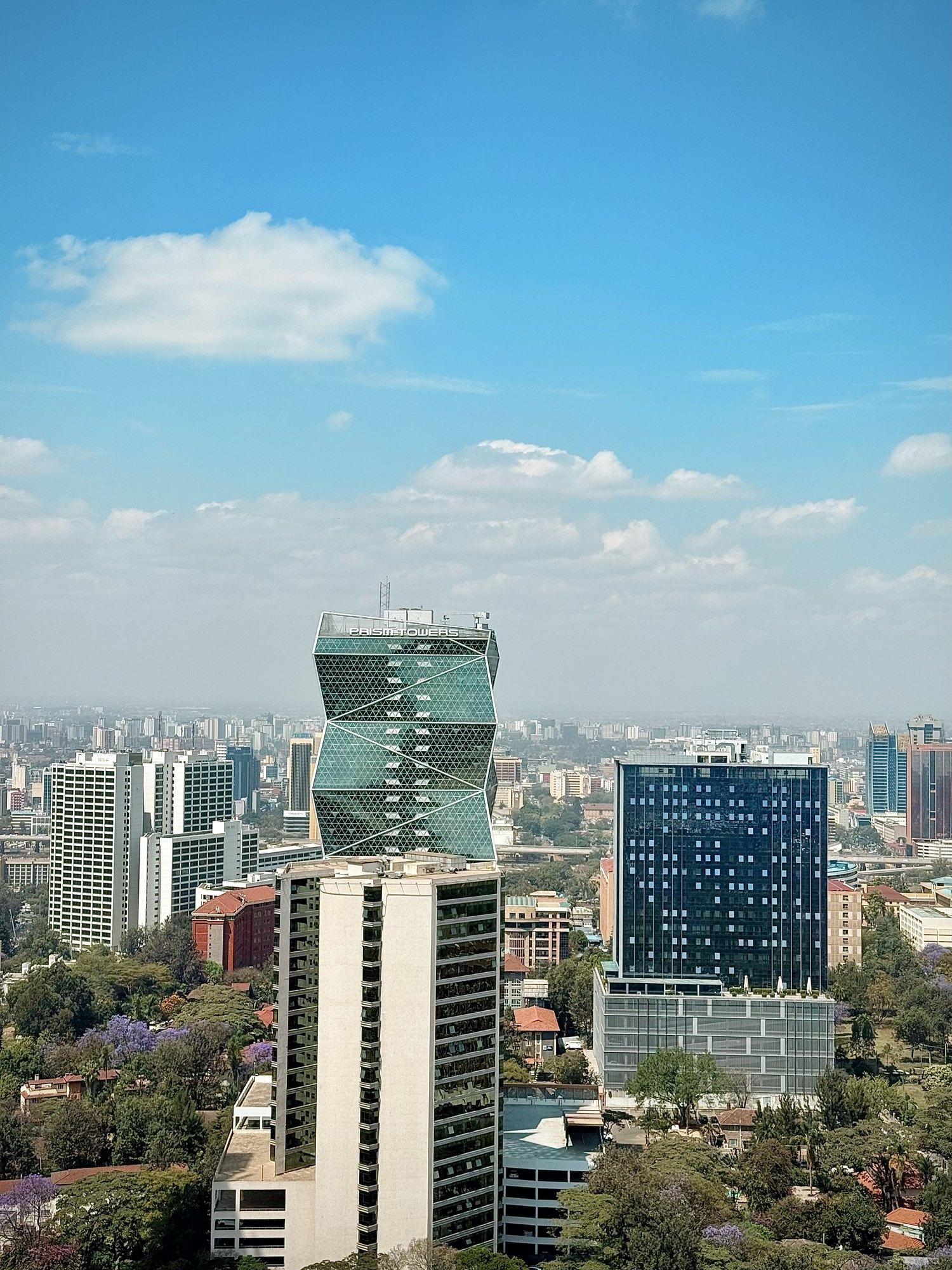
Most people who end up in Upper Hill did not choose Nairobi so much as choose a building in it. A meeting at a bank. A conference at a head office. An appointment at a hospital that happens to be one of the best in the region. The neighbourhood is the reason for the trip, and the question is only where to sleep within walking distance of it.
That is worth saying plainly, because Upper Hill is not a tourist neighbourhood and does not pretend to be. It is a working district on a ridge south-west of the city centre, quiet at night, busy from seven in the morning, and full of people who are here to do one specific thing.
What is actually here
Upper Hill holds a striking amount of Kenya’s commercial weight in a small area. Several of the country’s largest banks have their head offices on or beside Hospital Road and Upper Hill Road. So do a number of insurers, law firms and regional bodies. If your trip involves a meeting with a Kenyan institution, there is a good chance the address is here.
Alongside that sits the medical cluster: Nairobi Hospital and Kenyatta National Hospital are both in or adjacent to the neighbourhood, along with a dense ring of specialist clinics and diagnostic centres. People travel from across East Africa for treatment here, which is why a serviced apartment in Upper Hill is often booked by a family rather than a business traveller.
What Upper Hill does not have much of is nightlife. For restaurants and bars beyond hotel dining, people head to Kilimani or Westlands, both a short drive away. That is a fair trade for how quiet it is after dark.
The three ways people stay here
- Business hotels. Convenient, predictable, and priced for expense accounts. Excellent for two nights. Less appealing by the second week, when you have eaten every item on the room-service menu.
- Serviced apartments. A kitchen, a desk, laundry, and space to spread out. Better value beyond about four nights, and the obvious choice if you are cooking, working, or accompanying someone through treatment.
- Rooms in Kilimani or Hurlingham. Cheaper, and only ten minutes away — except at eight in the morning, when ten minutes becomes forty. Nairobi traffic is the deciding factor more often than people expect.
We wrote a longer comparison of serviced apartments against hotels if you are weighing the first two.
The single most useful question is not “how far is it?” but “can I walk?”. If your appointment is in Upper Hill and your bed is in Upper Hill, you never once have to think about traffic — which, in this city, is worth more than the price difference.
Getting around
Within the neighbourhood, walking is genuinely practical: pavements are reasonable and the distances are short. For anywhere else, ride-hailing apps are cheap, plentiful and how almost everyone moves. From the airport, allow far more time than the distance suggests — we set out realistic numbers in getting from JKIA to Upper Hill.
The Expressway has genuinely changed the airport run. The rest of Nairobi has not changed at all, so a 6km trip across town at the wrong hour is still an hour of your life.
Choosing a building
Three things matter more than the photographs, and none of them appear in a listing title.
- Backup power. Outages are not constant, but they happen. A building with a generator is the difference between an inconvenience and a lost working day.
- Water. Ask whether the building has its own storage. Everyone who has stayed in Nairobi for a month knows why.
- Lifts and security. A tower with one working lift at eight in the morning will teach you patience. Twenty-four-hour security and access control are standard in newer buildings and worth insisting on.